

Revenue cycle teams did not start using AI because it sounded innovative. They started using it because the volume of routine encounters outgrew what a human team could process without cutting corners somewhere. AI did not solve a strategic problem first. It solved a throughput problem, and everything else followed from that.
AI medical coding tools read clinical notes, suggest ICD-10 and CPT codes, and flag billing errors before claims leave the building. AI in medical billing catches charge gaps and scores claims by denial risk before submission. Neither replaces coders. Both change what coders spend their time on.
How AI works in coding and billing workflows
The core technology behind most medical coding AI is natural language processing. A physician writes a clinical note in free text. An NLP model trained on millions of similar notes reads that text, identifies clinically relevant concepts — diagnoses, procedures, symptoms, lab findings — and maps them to the appropriate ICD-10-CM or CPT codes.
Medical coding and AI integration typically works in one of two modes. In the first, the AI suggests codes that a human coder reviews and approves before submission. In the second, the AI autonomously assigns codes for routine encounter types — simple office visits, common procedures, straightforward diagnoses — while flagging complex cases for human review. Most production environments use a combination of both, routing by complexity.
Machine learning adds a layer on top of NLP. Models trained on a health system's own historical claims data learn which codes are commonly paired together, which combinations trigger denials with specific payers, and where the gap typically sits between what a physician documents and what gets coded. That institutional pattern recognition is harder to replicate manually.
Benefits of AI in medical coding
The headline benefit is throughput. A human coder reviews one chart at a time. An AI system processes thousands in parallel. For health systems running large volumes of outpatient encounters, that difference matters in ways that scheduling and hiring cannot address.
AI for medical coding also addresses the consistency problem. Human coders vary in experience and specialization. An outpatient coder who understands orthopedic encounters well may struggle with the nuance of oncology documentation. AI models trained across specialties apply consistent logic regardless of encounter type.
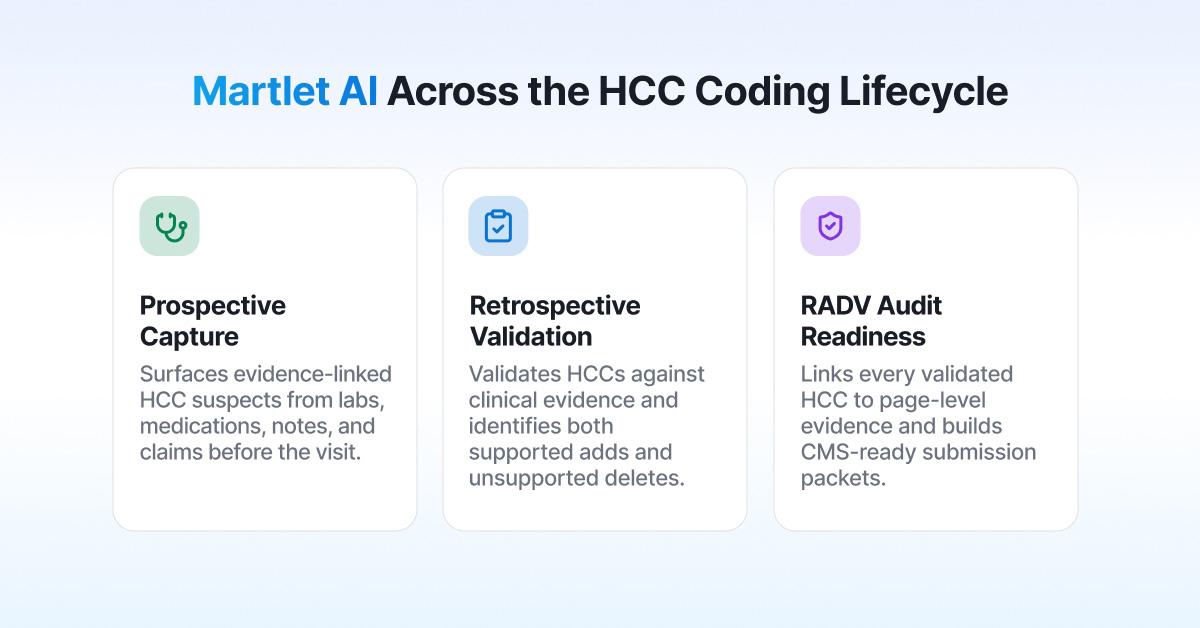
For risk adjustment programs specifically, AI surfaces coding opportunities that manual workflows routinely miss. In Prospective Risk Adjustment, NLP-driven pre-visit chart review identifies chronic conditions documented in prior records that have not been captured in current-year encounters, giving physicians the chance to address them before the visit ends. In Retrospective Risk Adjustment, AI can process far more completed records than a manual chart review team, recovering legitimate diagnoses that did not make it through the original coding workflow.
Accuracy improvements are real but conditional. AI models perform well on encounter types they have seen in training data. On unusual cases, rare diagnoses, or encounters with atypical documentation, model confidence drops and human review becomes more important, not less.
Benefits of AI in medical billing
On the billing side, the highest-value application is pre-submission claim scrubbing. Medical billing AI tools check outgoing claims against payer-specific rules before submission, catching errors that would generate a denial, a request for additional information, or a payment reduction.
AI in medical billing also handles charge capture gaps. A physician performs a procedure, documents it in the note, but the charge never makes it into the billing system. AI tools that cross-reference clinical documentation against submitted charges find those gaps systematically. In high-volume environments where manual reconciliation is impractical, the revenue recovery from closing those gaps can be significant.
Denial prediction is a third area where machine learning has practical value. Models trained on historical denial patterns score new claims by their likelihood of denial with a specific payer — based on the combination of diagnosis codes, procedure codes, patient demographics, and prior claim history with that payer. That scoring lets billing teams intervene on high-risk claims before they go out rather than chasing denials after the fact.
Real-world use cases and examples
Large health systems with high outpatient volumes have used AI coding tools to reduce average coding turnaround time from days to hours on routine encounter types, freeing coders to focus on complex inpatient cases where human judgment adds the most value.
Medicare Advantage plans have deployed NLP platforms to run retrospective chart review across member populations at a scale that manual review could not achieve within submission deadlines. The practical result is more complete HCC coding going into the annual risk adjustment data submission.
RADV audit preparation is a concrete application worth noting. When CMS selects records for audit, AI platforms can process sampled records quickly, surfacing the supporting documentation for each submitted HCC diagnosis and flagging cases where the documentation may not hold up under scrutiny. That gives compliance teams a realistic picture of audit exposure before CMS finishes its own review.
Revenue cycle teams at regional hospitals have used denial prediction models to identify the billing patterns that generate the most denials with their highest-volume payers, then corrected those patterns at the source — in documentation templates and coder training — rather than treating each denial individually.
Challenges and limitations of AI adoption
Data quality is the first obstacle. An NLP model trained on clean, well-structured clinical notes from one health system may underperform on the fragmented, inconsistently formatted documentation from another. Getting AI tools to perform reliably across a health system's full range of documentation styles requires significant training data and ongoing model validation.
EHR integration is frequently harder than vendors suggest. Clinical documentation lives in systems that were not designed for easy data extraction. Structured data fields, free-text notes, scanned documents, and imported records from outside facilities all need to be accessible for a coding AI to work effectively. That integration work takes time and technical resources that most implementation timelines underestimate.
Clinician trust is a practical barrier that does not get discussed enough. Physicians who understand that AI is reading their notes and suggesting codes based on them sometimes change their documentation habits in ways that are not helpful. Getting clinical staff to understand what AI tools actually do — and do not do — with their notes is part of implementation that vendors rarely help with.
Model drift is the problem that surfaces six to twelve months after go-live. Train a model on 2022 encounter data, run it through 2025 without retraining, and it will be generating codes against guidelines that no longer exist. ICD-10 updates annually. Payer policies change. A model that was accurate at deployment degrades quietly unless someone is actively monitoring its outputs and scheduling retraining.
Compliance, documentation, and audit considerations
CMS does not care how a code was identified. The documentation has to support it. A machine reading a physician note and flagging a diagnosis does not make that diagnosis submittable — it makes it a candidate for review.
This is especially relevant in risk adjustment. MEAT criteria exist independent of whatever technology surfaced the diagnosis. A coder who sees an AI flag pointing to a problem list entry with no encounter-level management documented has found a lead, not a code. Submitting it without documentation support creates audit exposure that lands on the coder and the plan, not the software vendor.
Good governance requires clearly defined routing rules covering which AI outputs need a human sign-off before submission and which can go straight through, a documented audit trail for every reviewed code, and a process for updating those rules when compliance requirements shift. Setting policies at go-live and never revisiting them is its own category of risk.
The role of human coders and hybrid workflows
The replacement conversation keeps recurring. It is the wrong conversation. In every serious implementation, the actual outcome is a division of labor that follows from error rates, not philosophy: high-volume routine encounters go to the model, everything requiring judgment stays with humans.
What shifts is productivity and, quietly, skill requirements. Fewer coders can process the same volume. But the coders handling model escalations are working harder cases than the ones that used to fill their queues. Some find that genuinely more engaging. Others find it more demanding. Both reactions are reasonable.
Quality assurance is the underrated piece. In a hybrid workflow, someone needs to regularly pull a sample of AI outputs, check them against documentation, and report back on where the model is slipping. That function did not really exist before. Most departments are still figuring out who owns it.
Measuring success with AI in coding and billing
Most AI vendors provide a dashboard. Most dashboards track activity, not outcomes — clicks, volumes processed, suggestions generated. None of that determines whether the investment is working.
Coding accuracy on a blinded sample of AI-assisted encounters compared to the same types coded manually is the only clean way to see what the model is actually doing. First-pass denial rate broken out by payer and encounter type, before and after deployment, shows whether the billing side moved. Turnaround time on routine encounters should decrease; if it has not, the model is not handling the volume it was supposed to handle.
Audit findings on AI-assisted submissions deserve their own tracking. If RADV or external audits are finding more errors in model-coded records than in manually coded ones, that signal needs a response before it becomes a formal finding. Revenue per encounter where AI is surfacing additional codes or charge gaps is the hardest to measure cleanly — and often where the real return is.
Future trends in AI for coding and billing
Generative AI in documentation improvement is the most interesting near-term development. Instead of reading a finished note and coding from it, some tools now prompt physicians during documentation — surfacing that "uncontrolled diabetes" in the current note does not capture the nephropathy stage that would change the code. Getting that feedback into the clinical workflow before the note is finalized is worth considerably more than recovering it in retrospective review.
EHR vendors are building AI natively rather than through third-party integrations. That matters because most of the friction in current implementations comes from the integration layer, not the model itself. As that friction decreases, deployment cycles should shorten.
On denials, the gap between "this claim will probably be denied" and "here is the specific field causing it and here is how to fix it" is where the next round of tools is focused. That is a more useful output than a probability score.
Real-time code suggestions appearing as physicians finish their notes is technically ready. The open question is whether physicians will engage with feedback mid-charting without it adding time they do not have.
AI delivers real value in coding and billing — with governance that matches the stakes
AI is doing real work in coding and billing today — not in pilots, not in press releases, but in production workflows at health systems and health plans that measured the results and kept running the tools. Volume processing, denial prediction, HCC gap identification, charge capture recovery: these are areas where the technology has proven out.
What it has not done is make implementation easy or make governance optional. The organizations getting the most value treat AI as infrastructure that requires maintenance, oversight, and honest measurement. The ones that bought a tool expecting it to run itself tend to find out what they missed when the audit results come back.
If you are evaluating how Martlet AI applies clinical NLP and HCC automation to risk adjustment coding programs inside your environment, see how the platform works or schedule a working session with the team.
FAQ
What kinds of AI are used in medical coding and billing?
NLP handles the reading: clinical text goes in, diagnosis and procedure concepts come out, mapped to ICD-10-CM or CPT. Machine learning adds the institutional knowledge — which code combinations specific payers reject, where charge gaps tend to appear in particular encounter types, how to score a new claim's denial risk based on what happened with similar claims before. Most systems also layer in rule-based logic for straightforward assignments.
Can AI replace human medical coders?
Not realistically. The model does well on encounter types it trained on. It struggles with clinical ambiguity, unusual presentations, and documentation that requires interpretation rather than pattern matching. Physician queries, complex inpatient cases, and audit response all stay with humans. The practical outcome in most deployments is that the same team processes more volume, with the harder cases concentrated on the experienced coders.
What are common challenges in implementing AI for billing?
Most implementations underestimate two things: how messy the source data is, and how long EHR integration actually takes. A model that works well on clean structured notes often performs poorly on the real-world mix of free text, scanned records, and imported documents. Legacy EHR connections almost always take longer than scoped. Clinician trust and model drift are the problems that surface six to twelve months after go-live.
How does AI impact revenue cycle performance?
First-pass denial rates improve when pre-submission scrubbing catches errors before they go out. Coding turnaround shortens on routine encounters. Charge capture gaps that manual reconciliation routinely missed get found. In risk adjustment, retrospective NLP review recovers HCC diagnoses that did not make it through the original coding workflow. The magnitude depends on how leaky the existing process was before AI came in.
What compliance issues should healthcare organizations watch for?
The documentation has to support every submitted code, regardless of how it was identified. AI does not change that. For risk adjustment, MEAT criteria apply whether a human or a model surfaced the diagnosis. Organizations need written routing rules covering which AI outputs require coder review before submission, a documented audit trail for each approved code, and a process for updating those rules when compliance requirements change. Setting policies at go-live and never revisiting them is its own risk.