
Blog
 Insights
Hasham Ul HaqOctober 15, 2026
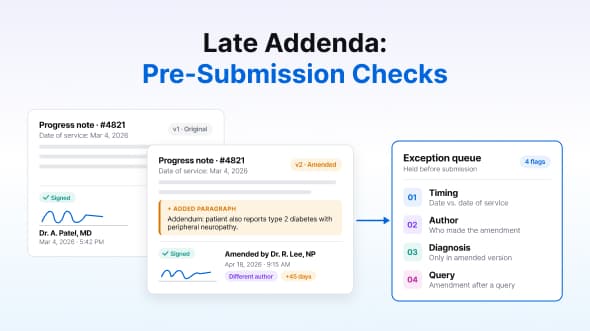
Amendment provenance: catching late addenda before submission
Amendment provenance is the record of who changed a clinical note, when, and how. It became a coding-engine requirement in 2026. The August 26 False...
Read post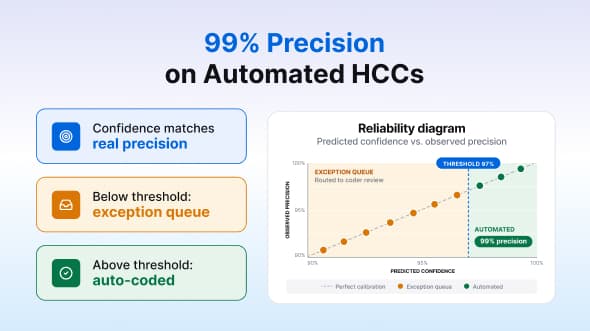 Insights
October 13, 2026
99% precision on automated HCCs: the evaluation protocol
Precision on automated HCCs is the share of codes an engine closes without human review that a certified coder, reading the same chart against MEAT ...
Read post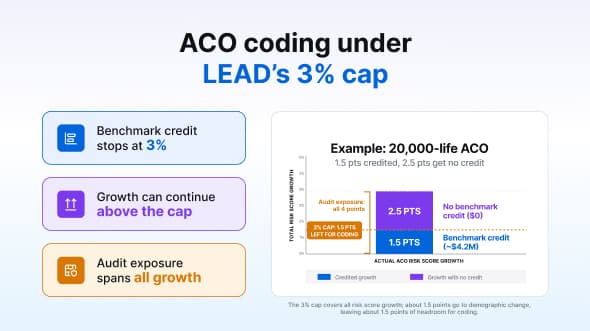 Insights
October 8, 2026
ACO coding under LEAD’s 3% cap: accuracy over capture in 2027
A risk-score cap limits how much an ACO’s average risk score can raise its benchmark relative to a reference year. The Long-term Enhanced ACO Design...
Read post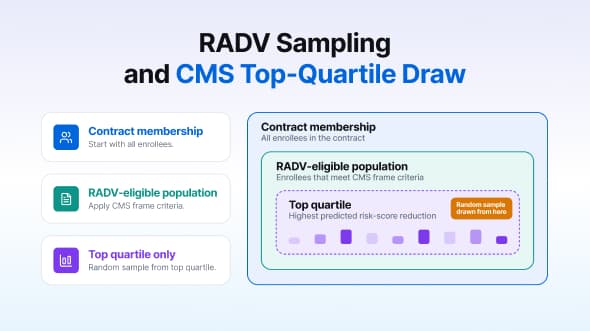 Insights
October 6, 2026
RADV sampling frame: matching CMS’s top-quartile draw in a mock audit
A RADV sampling frame is the set of enrollees CMS draws from when it selects a contract’s audit sample, and for PY2024 it is the enrollees CMS’s own...
Read post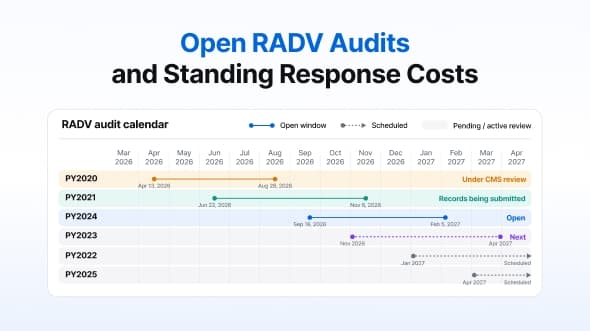 Insights
October 1, 2026
Four open RADV audits: staffing and cost of a standing response program
A Medicare Advantage plan selected in every cycle now has four RADV audits open at once. PY2020 records went in on August 28 and findings are pendin...
Read post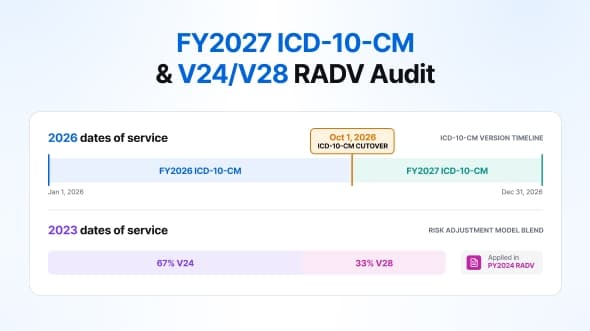 Insights
September 22, 2026
Payment-year discipline: FY2027 ICD-10-CM and the first blended V24/V28 RADV audit
Payment-year discipline means every HCC an engine produces is resolved against the code set, risk model, and eligibility rules that applied on its d...
Read post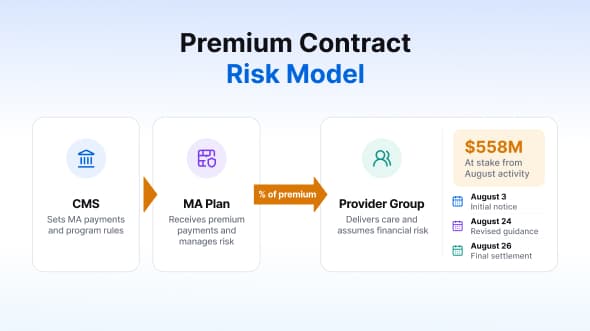 Insights
September 17, 2026
Percentage-of-premium contracts: the $558M August lesson for risk-bearing providers
A percentage-of-premium contract pays a provider group a fixed share of what a Medicare Advantage plan receives from CMS for its members. In August ...
Read post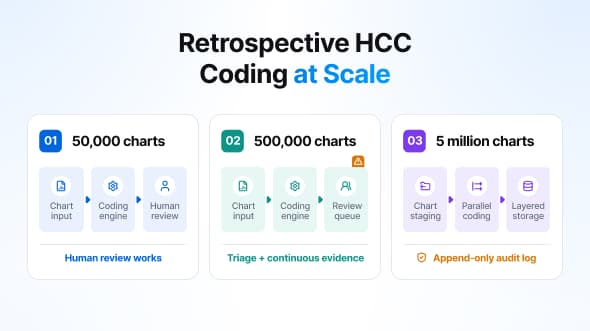 Insights
September 15, 2026
What changes in retrospective HCC coding at million-chart scale
A retrospective HCC coding program that runs cleanly at 50,000 charts a year often hits hard walls at 500,000 and breaks outright at 5 million. The ...
Read post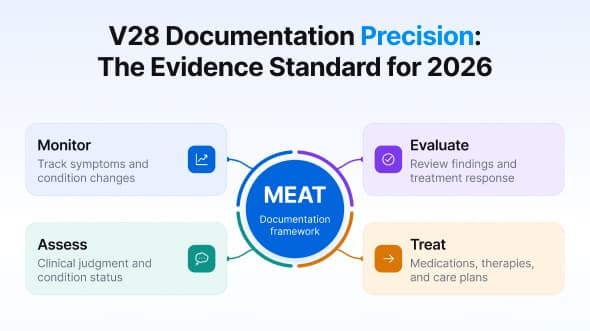 Insights
September 10, 2026
V28 documentation precision: MEAT criteria and the evidence standard for 2026
What counts as defensible documentation for risk-adjustment payment in 2026 isn't what counted in 2023. The MEAT criteria for HCC coding haven't cha...
Read post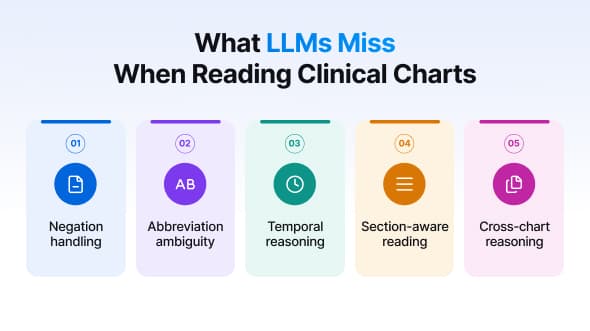 Insights
September 8, 2026
What general-purpose LLMs miss when reading a clinical chart
A frontier general-purpose large language model can pass the USMLE and answer medical board exam questions at near-human accuracy (Nature Scientific...
Read post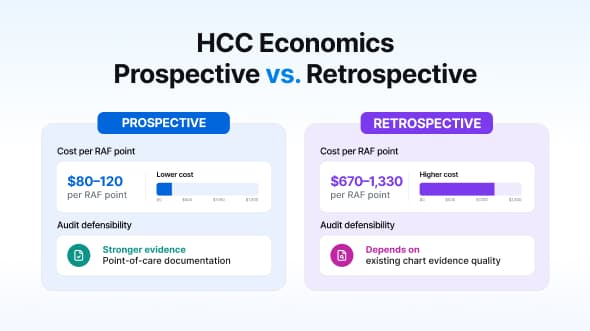 Insights
September 3, 2026
Modeling prospective versus retrospective HCC capture economics
For a 200,000-life Medicare Advantage plan trying to maximize defensible RAF capture in 2026, the question isn't whether to invest in prospective or...
Read post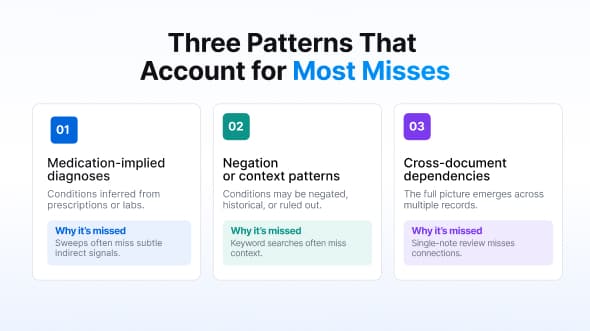 Insights
September 1, 2026
Why retrospective HCC sweeps miss chronic conditions documented in the chart
A diabetic patient sees their primary care doctor twice in a year. First visit, the encounter note reads "A1c 8.2, refilling metformin and adding gl...
Read post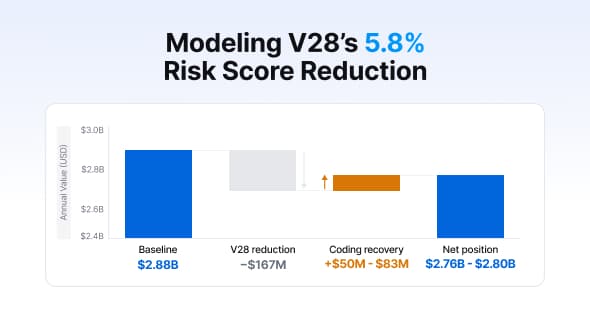 Insights
August 27, 2026
Modeling V28's 5.8% risk score reduction for a 200,000-life Medicare Advantage plan
The peer-reviewed academic literature has measured the V28 impact in production. A Health Affairs Scholar analysis published in April 2026(https://a...
Read post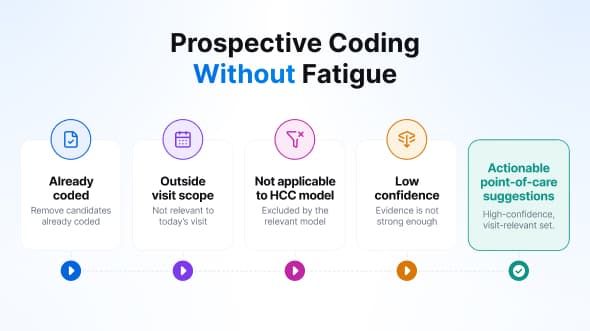 Insights
August 25, 2026
Prospective HCC coding without query fatigue: a point-of-care design
A primary care physician sees twenty patients in a clinic day. If half get a prospective HCC suggestion in the EHR ("diabetic neuropathy not coded t...
Read post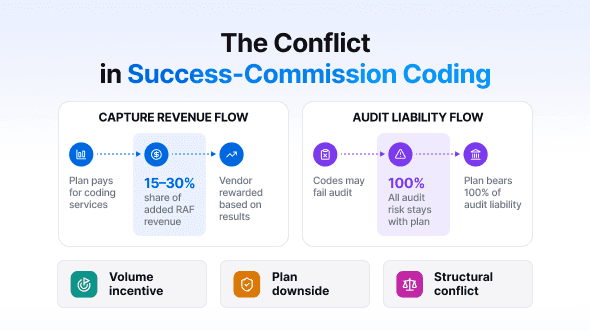 Insights
August 20, 2026
Success-commission HCC coding: the structural conflict of interest
Picture a tax firm paid 20% of every deduction it finds. The firm has every incentive to find more deductions and push the envelope on what's defens...
Read post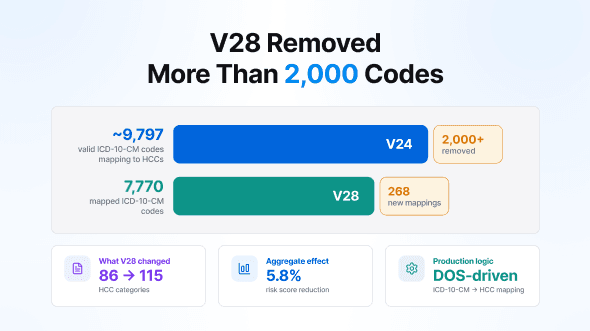 Insights
August 18, 2026
V28 in production: the 2,000 codes that no longer count
January 1, 2026 was the first day Medicare Advantage risk-adjustment payment was calculated entirely from the V28 model. The blended V24/V28 transit...
Read post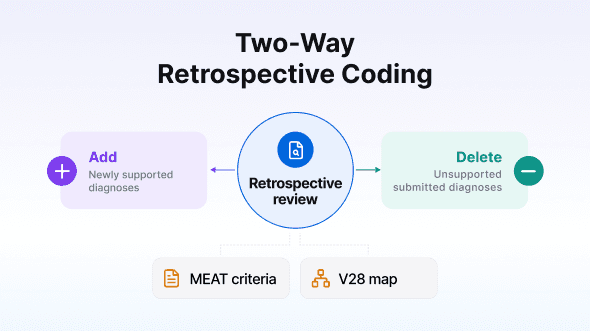 Insights
August 13, 2026
Two-way retrospective coding: the new standard after 2026 settlements
On March 11, 2026, the Department of Justice announced a $117.7 million False Claims Act settlement(https://www.justice.gov/opa/pr/aetna-agrees-pay-...
Read post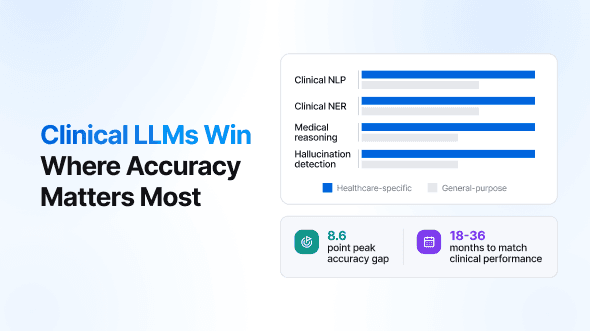 Insights
August 11, 2026
The 8.6-point accuracy gap between healthcare-specific and frontier LLMs
Pick any task involving extraction from real clinical text: diagnosis identification from notes, medication-condition mapping, MEAT validation, code...
Read post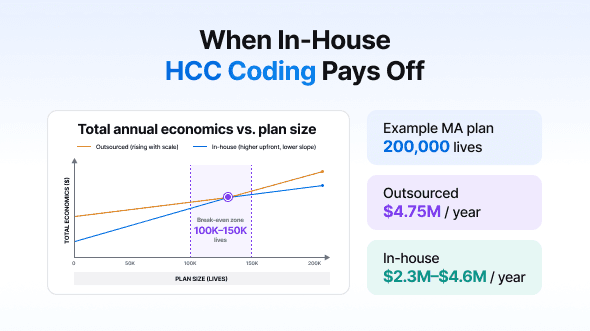 Insights
August 6, 2026
The break-even on bringing HCC coding in-house
I've spent the last year having the same conversation with CFOs at health plans and risk-bearing provider organizations. It starts with a number, us...
Read post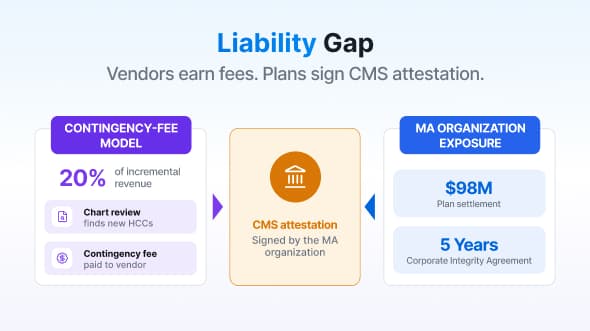 Insights
August 4, 2026
In-house vs. outsourced HCC coding in 2026: the cost model and the accountability gap
The case for outsourcing HCC coding rested on two premises: an external vendor reviews charts more cheaply than an in-house team, and the vendor car...
Read post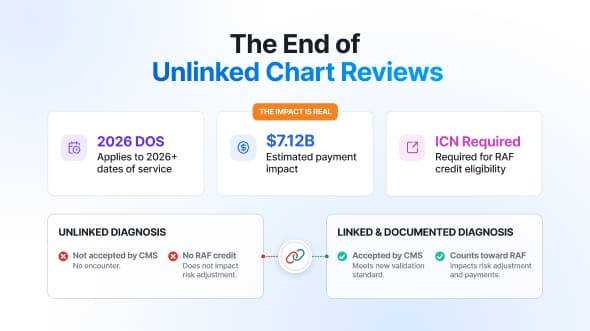 Insights
July 30, 2026
CMS ends unlinked chart reviews in Medicare Advantage: preparing HCC coding for the $7.12B change
An unlinked chart review record (CRR) adds a diagnosis to a Medicare Advantage member's risk profile without tying it to any submitted encounter. St...
Read post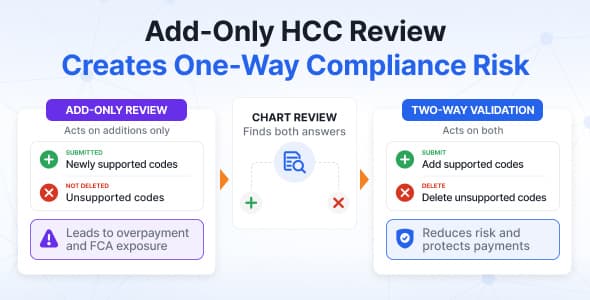 Insights
July 28, 2026
The end of add-only HCC coding: building two-way retrospective review after a $117.7M FCA settlement
Two-way retrospective review validates every HCC a chart review touches: it submits newly supported codes and deletes previously submitted codes the...
Read post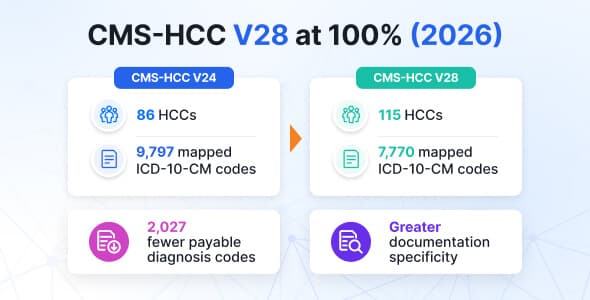 Insights
July 23, 2026
CMS-HCC V28 at 100%
Payment year 2026 is the first year every Medicare Advantage risk score is calculated entirely under CMS-HCC V28. The model maps 7,770 ICD-10-CM cod...
Read post Insights
July 21, 2026
Certified Risk Adjustment Coder (CRC): what they do and whether your plan needs one
A Certified Risk Adjustment Coder (CRC) is a credentialed professional who reviews clinical documentation and assigns ICD-10-CM diagnosis codes to s...
Read post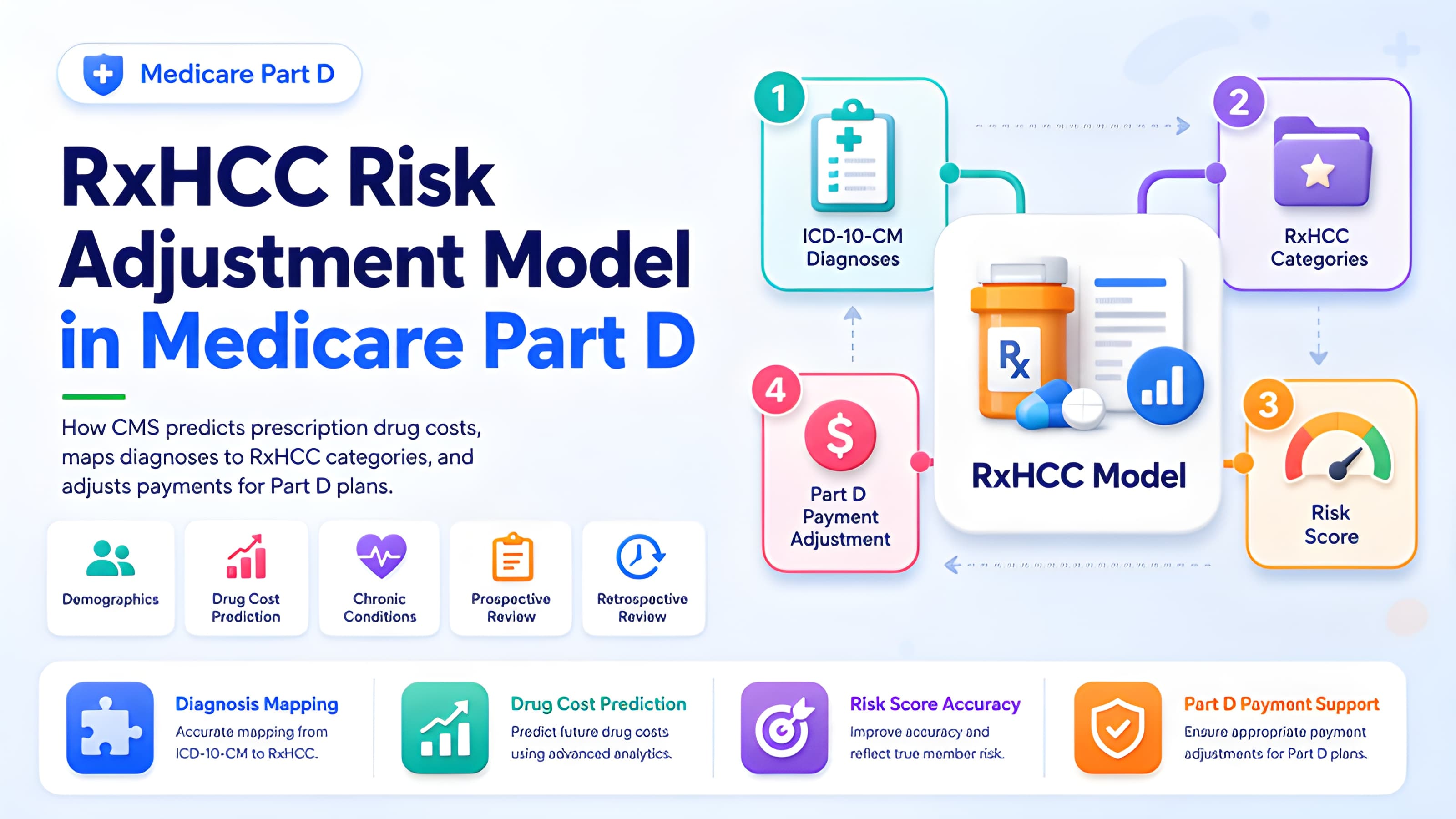 Insights
July 16, 2026
RxHCC explained: how Medicare Part D risk adjustment affects your drug plan revenue
RxHCC stands for Prescription Drug Hierarchical Condition Categories. It is the risk adjustment model CMS uses specifically for Medicare Part D — th...
Read post Insights
July 14, 2026
HCC coding gaps: how to find them before CMS does
HCC coding gaps occur when a patient's chronic conditions are present in their clinical history but do not make it into the risk adjustment data sub...
Read post Insights
July 9, 2026
Medicare Advantage rate changes in 2026: what risk adjustment leaders need to do now
Every private insurer running a Medicare Advantage plan gets paid by the federal government to do it. Those payments — monthly, per member, calibrat...
Read post Insights
July 7, 2026
HCC risk adjustment coding: the documentation mistakes that trigger RADV audits
Billing in Medicare Advantage does not work the way it does in fee-for-service. Providers do not get paid per procedure. Health plans receive a mont...
Read post Insights
July 2, 2026
CMS HCC v28: the model changes and what they mean for your Medicare Advantage revenue
CMS does not update its Medicare Advantage risk adjustment model often. When it does, the changes ripple through every health plan's finances, codin...
Read post Insights
June 30, 2026
Prospective vs. retrospective risk adjustment: which approach closes more coding gaps?
Health plans and provider organizations do not have a single moment to get risk adjustment right. Patient conditions need to be documented, coded, a...
Read post Insights
June 25, 2026
What your RAF score actually reveals about your risk adjustment program
The Risk Adjustment Factor (RAF) is a numeric score that healthcare payment systems use to estimate how much a given patient is likely to cost relat...
Read post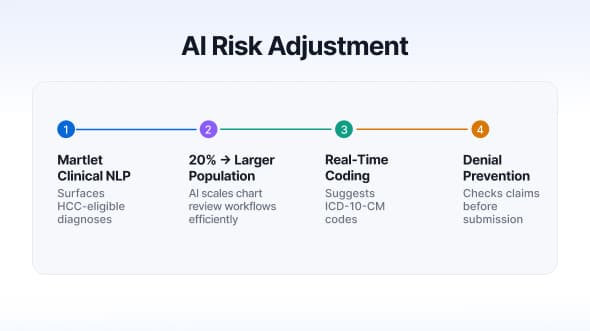 Insights
June 23, 2026
What AI actually does to risk adjustment accuracy — and where it still falls short
Risk adjustment has always been a data problem. The model is only as accurate as the diagnoses feeding into it, and diagnoses are only as complete a...
Read post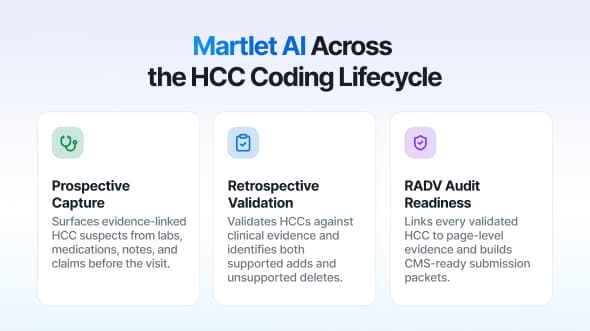 Insights
June 18, 2026
AI in medical coding: what actually works for health plans and what to ignore
Revenue cycle teams did not start using AI because it sounded innovative. They started using it because the volume of routine encounters outgrew wha...
Read post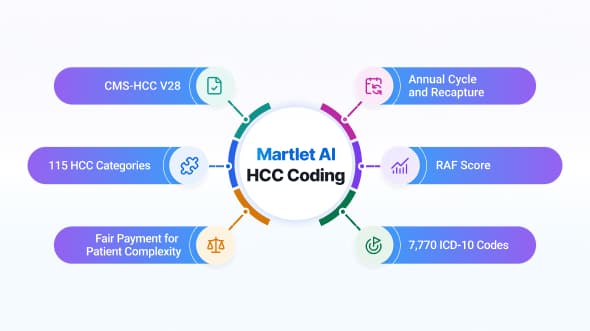 Insights
June 17, 2026
Why risk adjustment coding mistakes cost Medicare Advantage plans millions
Healthcare has never paid everyone the same rate. A patient managing diabetes, heart failure, and chronic kidney disease costs far more to cover tha...
Read post Insights
June 10, 2026
What is HCC coding and why does it determine your Medicare Advantage revenue?
HCC coding is the risk adjustment methodology CMS uses to estimate patient disease burden and calibrate reimbursement in Medicare Advantage and othe...
Read post Insights
April 9, 2026
70% of AI-Generated HCC Suspects Were Rejected. Here's Why That Happens
Hierarchical Condition Category (HCC) coding is one of the areas in healthcare where AI is the obvious solution. On paper, it makes perfect sense. U...
Read post Product
February 3, 2026
How Healthcare-Specific Language Models Are Transforming HEDIS and Stars Performance
Healthcare-Specific Language Models — AI models trained exclusively on clinical and biomedical data that accurately understand medical terminology, ...
Read post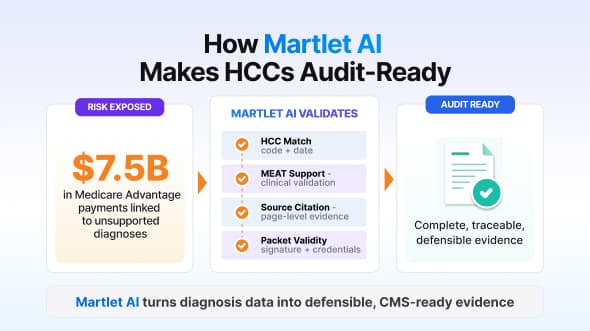 Product
December 15, 2025
RADV Audit Readiness for Health Plans: Reducing Clawback Risk and Strengthening Compliance with AI-Driven Workflows
Clawback Risk — the financial exposure a health plan faces when unsupported diagnoses identified in a RADV audit sample are extrapolated across the ...
Read post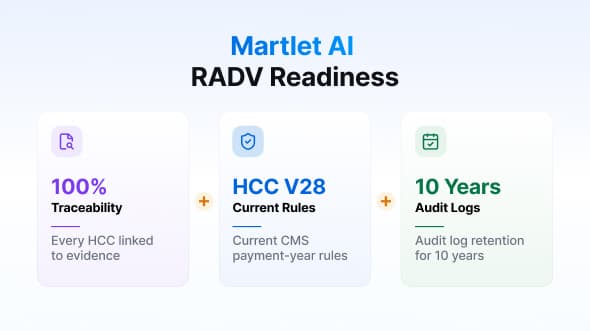 Product
December 15, 2025
RADV Audit Readiness: What Compliance Teams Should Ask Their Vendors
Audit-Ready HCC Coding Platform — a compliance-focused system that applies current CMS payment-year rules to risk-adjusted diagnoses, links each HCC...
Read post