
Certified Risk Adjustment Coder (CRC): what they do and whether your plan needs one

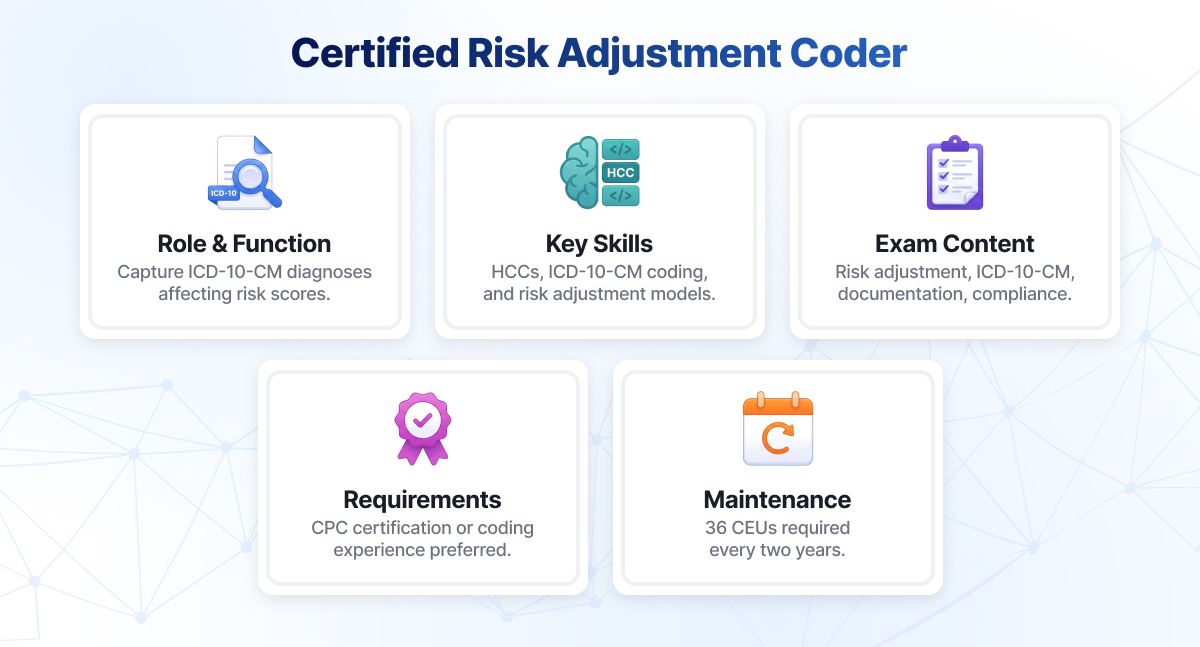
A Certified Risk Adjustment Coder (CRC) is a credentialed professional who reviews clinical documentation and assigns ICD-10-CM diagnosis codes to support accurate reimbursement in Medicare Advantage, Medicaid, and ACA marketplace plans. The credential is issued by the American Academy of Professional Coders (AAPC) and is the benchmark certification that health plans, risk adjustment vendors, and government programs look for when hiring in this specialty.
A CRC reviews patient medical records to find and validate ICD-10-CM diagnosis codes that drive RAF scores and HCC-based payments. Getting certified means passing a proctored AAPC exam on diagnosis coding, risk adjustment models, and compliance. Health plans, hospital systems, and risk adjustment vendors hire CRC professionals specifically to reduce revenue leakage and hold up under audit.
Why CRC certification is important in healthcare
The basic financial reality of risk adjustment: if a patient's chronic conditions are documented in the chart but never coded, the health plan gets underpaid for the actual cost of caring for that person. Submit codes that are not backed by documentation, and the plan faces repayment demands. Both problems are common, and both are expensive.
That is where a risk adjustment coder with CRC credentials comes in. The credential signals that a coder understands not just the coding rules, but the compliance framework around them. Risk adjustment errors are not only a billing problem — patterns of unsupported coding can draw False Claims Act scrutiny, federal investigations, and recoupment demands that run into the millions.
Health plans manage this exposure through two distinct workflows. Prospective Risk Adjustment finds documentation gaps before the plan year closes, so clinical teams still have time to address them through care coordination or supplemental data capture. Retrospective Risk Adjustment goes back through completed encounters after the service year to confirm that every substantiated diagnosis made it into the final submission.
CRC professionals work in both. Knowing which diagnoses are supported, which need a physician query, and which cannot be coded without better documentation is what separates a qualified CRC coder from someone working through a checklist.
| Workflow | Timing | CRC role |
|---|---|---|
| Prospective | Before year-end | Identify under-coded chronic conditions; flag documentation gaps for physicians |
| Retrospective | After service year | Review completed charts; validate HCC-eligible diagnoses for final submission |
| RADV audit response | On-demand | Locate medical record support for codes selected in CMS audit samples |
Skills required for a risk adjustment medical coder
General coding experience helps, but a risk adjustment medical coder operates in territory that most outpatient or inpatient coders have not had to navigate. The work is almost entirely diagnosis-driven, which changes the skill priorities considerably.
ICD-10-CM proficiency is the foundation. Unlike fee-for-service coding, there is no procedure side here. Everything depends on diagnosis codes applied at the right level of specificity. A code that is one level too general may not map to any HCC at all, which means zero reimbursement impact even if the condition is clinically significant.
Clinical documentation interpretation is the second core skill. CRC coders have to read the full picture: physician notes, discharge summaries, lab results, specialist consults. The question they are answering is whether a diagnosis is documented, evaluated, treated, or managed during the encounter. That is the MEAT framework, and it is what CMS auditors check first.
Understanding of risk adjustment payment models separates good coders from great ones. Knowing that a diagnosis maps to HCC 18 matters less than understanding what HCC 18 means for the plan's RAF score and monthly capitated payment. Coders who grasp the payment logic catch issues that pure ICD-10-CM knowledge misses.
Compliance and audit fluency rounds out the skill set. The False Claims Act does not only apply to intentional fraud. Sloppy coding at scale can look like a pattern even when it is not. CRC professionals need to understand where the line sits between a coding error and something that triggers program integrity review.
Production-level chart review skills — query management, documentation flagging, knowing when to escalate versus when to move on — are practical competencies the AAPC exam does not test directly. Most experienced CRC coders develop them on the job.
CRC certification and the certification process
The CRC credential comes from the AAPC. No prior coding experience is required to sit for the exam, which makes it accessible to people transitioning from clinical roles or coming out of healthcare coding programs. Candidates without a background in ICD-10-CM typically spend more time in preparation.
AAPC recommends familiarity with medical terminology, anatomy, ICD-10-CM, and risk adjustment basics before testing. Many candidates already hold a CPC or CCS credential. Others complete AAPC's dedicated risk adjustment training course first.
The exam is 100 multiple-choice questions covering ICD-10-CM coding guidelines, risk adjustment model structure across CMS-HCC, RxHCC, and HHS-HCC, MEAT criteria, compliance regulations, and chart review scenarios. Candidates have two hours to complete it. AAPC uses scaled scoring — the exact passing threshold is in the candidate handbook at aapc.com and is worth checking before you test, since methodology can change between exam cycles.
Maintaining the credential requires 36 CEUs every two years. AAPC runs approved courses, and many health plans and vendors sponsor qualifying training internally. Exam fees depend on AAPC membership status and can be bundled with prep materials, which usually makes financial sense for first-time candidates.
If you already hold the CPC, the CRC exam will feel familiar in structure. ICD-10-CM coding guidelines are the shared foundation, so the learning curve is mostly about risk adjustment models and compliance context rather than starting from scratch.
Risk adjustment models used by CRC professionals
A certified risk coder does not work with one universal model. CMS has different frameworks for different programs, and the payment logic varies enough that coders who move between programs need to relearn some fundamentals.
The CMS-HCC model covers Medicare Advantage and is the one most CRC professionals encounter first. CMS maps ICD-10-CM codes to approximately 115 HCC categories under the current V28 model, phased in through 2025. Each HCC category carries a relative factor; add up a member's HCC factors, apply demographic adjustors for age and sex, and the result is the RAF score that drives the plan's monthly per-member payment from CMS.
The RxHCC model is built around drug utilization risk rather than medical cost and is used for Medicare Part D. Some diagnoses map here and not to the CMS-HCC model. CRC professionals doing Part D analytics work need to track which codes land where.
The HHS-HCC model covers the ACA Marketplace and drives risk adjustment transfers between insurers in the individual and small-group markets. The transfer payment logic differs from Medicare Advantage capitation, but the documentation and coding accuracy requirements are essentially the same.
| Model | Program | Payment mechanism | Key audit program |
|---|---|---|---|
| CMS-HCC (V28) | Medicare Advantage | Per-member monthly capitation | RADV |
| RxHCC | Medicare Part D | Plan risk scores for drug coverage | Part D risk corridor |
| HHS-HCC | ACA Marketplace | Insurer-to-insurer transfer payments | HHS risk adjustment audits |
RADV — Risk Adjustment Data Validation — is the CMS audit process that checks whether submitted HCC diagnoses hold up against medical record documentation. CRC professionals play a direct role in RADV preparation: pulling flagged records, finding the documentation that supports each code, and calculating the plan's expected payment error rate so there are no surprises when CMS completes its review.
Career opportunities for certified risk adjustment coders
The CRC credential opens doors in more places than most people starting out in the specialty expect. Because risk adjustment sits at the intersection of clinical documentation and health plan finance, CRC professionals are useful to organizations that do not always appear in traditional coding job searches.
Medicare Advantage health plans remain the largest employer in this specialty. MA plans run prospective chart review programs, retrospective supplemental data projects, RADV audit response teams, and provider documentation education initiatives — and CRC coders work across all of them.
Risk adjustment vendors and analytics firms need CRC professionals who can validate AI-suggested codes, lead quality assurance programs, and serve as subject-matter experts when new models or regulations come in.
Hospital systems and physician groups are hiring CRC coders as value-based contracts push hospitals to care about risk scores in a way they did not under straight fee-for-service. Large medical groups increasingly need certified coders to make sure chronic condition documentation reaches the payer's risk adjustment submission.
Government contractors and consulting firms — including CMS itself, state Medicaid agencies, and the firms that advise payers on program integrity — hire CRC professionals for compliance work, audit support, and policy analysis.
Healthcare technology companies building NLP-driven chart review tools and coding automation platforms need CRC professionals who can evaluate model output, design QA workflows, and bridge the gap between clinical accuracy and product requirements.
On compensation: AAPC's surveys put median earnings for risk adjustment coding specialists above $65,000, with experienced coders in health plan or vendor roles regularly reaching $90,000 to $110,000. It is consistently one of the better-compensated coding specialties in the AAPC data.
The role of technology and AI in risk adjustment coding
Running risk adjustment at health plan scale means processing millions of member-years of records. No team of manual reviewers can get through that volume fast enough to matter for prospective programs, which is why technology is now standard in how this work gets done.
Clinical NLP models trained on physician notes, discharge summaries, and specialist reports extract diagnosis mentions and MEAT-criterion evidence across thousands of charts at once. The output is not a finished coded record — it is a prioritized worklist for CRC coders, with the relevant documentation already surfaced.
Automated code suggestion tools propose ICD-10-CM codes from clinical text and rank them by confidence. CRC coders review each suggestion, accept what holds up, reject what does not, and modify anything that needs a more specific code. The coder stays accountable for every submission; the technology handles the volume.
Prospective gap prediction uses models trained on claims history, pharmacy data, and prior chart review results to identify members most likely to have undocumented HCC-eligible conditions — letting prospective programs focus outreach where it will have the most impact.
RADV preparation platforms track documentation status across hundreds of sampled records, flag charts with weak support, and model expected payment error before CMS finishes its review. When the audit clock starts, that head start matters.
The meaningful distinction among AI platforms is whether the underlying models are healthcare-specific from the ground up or general-purpose models applied to clinical text as a secondary use case. Those two architectures behave very differently on the core task of linking clinical text to HCC conditions and validating MEAT evidence. Independent, peer-reviewed benchmarking is the right standard to hold any platform to.
CRC certification connects coding accuracy to financial and compliance outcomes
CRC certification is the recognized benchmark for coders who work in risk-based payment programs. It validates the combination of ICD-10-CM knowledge, risk model fluency, and compliance awareness that health plans, vendors, and government programs require. Earning and maintaining it signals to employers that a coder can be trusted with work that directly affects plan revenue and audit exposure.
Risk adjustment is not getting simpler. CMS-HCC V28 expanded the model. RADV audits are more frequent. MA enrollment keeps growing. Health plans that pair qualified CRC coders with purpose-built technology produce more accurate submissions, absorb audits better, and recover more of the revenue they are owed.
If you are evaluating how Martlet AI supports risk adjustment programs with NLP-driven chart review and HCC coding automation, see how the platform works or schedule a working session with the team.
FAQ
What is a Certified Risk Adjustment Coder (CRC)?
A CRC is a healthcare professional credentialed by the AAPC who specializes in assigning ICD-10-CM diagnosis codes to support risk-based reimbursement in Medicare Advantage, ACA marketplace, and Medicaid managed care programs. The credential validates competency in ICD-10-CM coding, risk adjustment model structure, clinical documentation review, and compliance with CMS audit requirements.
How do you become a Certified Risk Adjustment Coder?
You pass the AAPC's CRC exam, which covers ICD-10-CM coding guidelines, HCC model structure, MEAT documentation criteria, and risk adjustment compliance rules. No minimum work experience is required, though most candidates who pass without difficulty either hold prior coding credentials or complete AAPC's preparatory course first. After passing, 36 CEUs every two years keep the credential active.
What does the CRC certification exam include?
One hundred multiple-choice questions covering ICD-10-CM diagnosis coding, CMS-HCC and HHS-HCC model structure, MEAT criteria for documentation sufficiency, compliance regulations including False Claims Act implications, and practical chart review scenarios. Two hours to complete. AAPC administers the exam and provides official prep materials.
What is the difference between CRC and other medical coding certifications?
The CPC covers outpatient coding broadly, including both diagnosis and procedure codes across multiple specialties. The CRC is narrower: it covers diagnosis coding specifically in risk adjustment programs and does not touch procedure coding, inpatient DRG coding, or specialty-specific billing. CRC professionals work with ICD-10-CM, risk adjustment models, and clinical documentation rather than CPT or HCPCS codes. Many CRC-credentialed coders also hold a CPC — the credentials address different parts of the work.
What career opportunities exist for certified risk adjustment coders?
CRC professionals work across Medicare Advantage health plans, risk adjustment vendors, hospital systems and physician groups taking on value-based contracts, government contractors and consulting firms, and healthcare technology companies building coding automation tools. Median compensation sits above $65,000, with experienced coders in health plan or vendor roles regularly reaching $90,000 to $110,000, making it one of the better-compensated coding specialties in the AAPC data.