

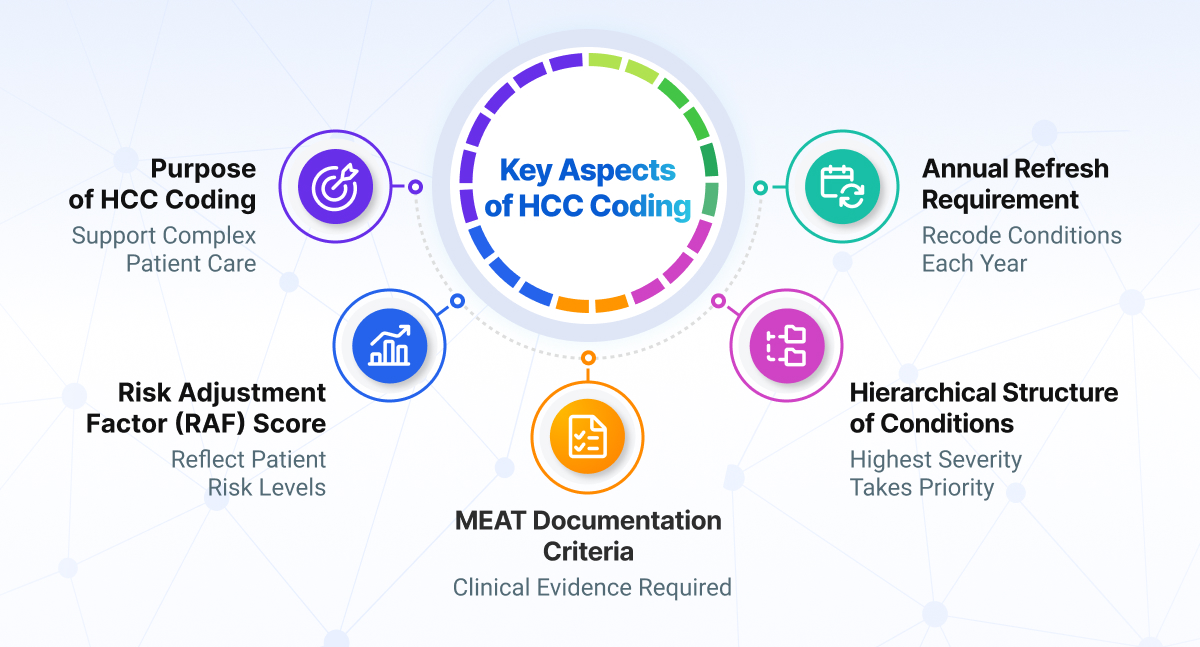
HCC coding is the risk adjustment methodology CMS uses to estimate patient disease burden and calibrate reimbursement in Medicare Advantage and other value-based programs. Documented diagnoses — expressed as ICD-10 codes — are mapped to Condition Categories associated with projected care costs. Those categories combine with demographic data to produce a Risk Adjustment Factor score that directly determines how much a payer receives to cover a given member.
HCC coding translates documented diagnoses into risk-adjusted categories tied to projected healthcare spending. Accurate capture drives RAF scores, value-based reimbursement, and population health planning. Documentation quality is as operationally important as the diagnosis itself — conditions not documented to ICD-10 specificity do not contribute to risk scoring regardless of clinical reality.
What is HCC coding
HCC coding is a risk adjustment methodology. Certain diagnoses, when documented with the appropriate ICD-10 code, are grouped into Hierarchical Condition Categories associated with predicted healthcare costs and long-term disease burden. Those categories then contribute to a member's overall RAF score.
The model is used primarily within Medicare Advantage programs, though risk-based reimbursement logic now shapes commercial plans, ACOs, Medicaid MCOs, and risk-bearing provider organizations as well. Payers, health systems, and RCM firms all rely on diagnosis-based risk modeling to estimate member complexity accurately.
One dimension that gets underweighted: HCC models are not purely financial instruments. They also drive patient stratification, chronic disease management prioritization, and long-term operational forecasting. And because they are directly tied to CMS compliance oversight, audit readiness has become a standing operational requirement — which is why solutions purpose-built for RADV Audits have moved from niche to core infrastructure across the industry.
Why is HCC coding important
The shift from fee-for-service to risk-adjusted reimbursement changed the financial stakes of diagnosis documentation. Under fee-for-service, payment tracked procedures and visit volume. Under risk adjustment, it tracks patient complexity — and patient complexity is only visible through coded diagnoses.
If chronic conditions are not captured correctly, a member population appears healthier on paper than it actually is. Across thousands of members, that gap translates directly into reimbursement shortfalls, care management miscalibration, and exposure in an audit. This is why the HCC coder role is no longer viewed as administrative in well-run organizations: coding quality now touches revenue integrity, compliance posture, and population health strategy simultaneously.
In risk-adjusted environments, documentation quality carries the same weight as the clinical diagnosis. A condition that exists clinically but is not documented to the specificity HCC mapping requires does not contribute to risk scoring. That gap is where most organizations lose ground.
The HCC meaning within healthcare operations has expanded accordingly. What began as a Medicare reimbursement mechanism now connects to analytics, provider engagement, and value-based care strategy at the program level. Organizations that manage it well typically run a combination of Prospective Risk Adjustment — reviewing gaps before encounters close — alongside Retrospective Risk Adjustment to identify missed opportunities and documentation inconsistencies after the fact.
HCC coding vs traditional ICD-10 coding
ICD-10 coding and HCC coding are related but serve different purposes.
ICD-10 codes document diagnoses and clinical conditions with specificity. They answer the question: what has this patient been diagnosed with during this encounter?
HCC models interpret that documentation differently. They take selected diagnoses and group them into Condition Categories associated with projected long-term healthcare costs. The question an HCC model answers is: given this patient's documented disease burden, what level of care utilization should we expect?
Not every ICD-10 diagnosis maps to an HCC category with material financial impact. Certain chronic and high-cost conditions — diabetes, congestive heart failure, COPD, chronic kidney disease — carry significant HCC weight. Acute or low-complexity conditions generally do not. The specificity of the ICD-10 code matters: a general diabetes code and a diabetes-with-complications code produce different HCC outcomes and different RAF contributions.
That distinction is where documentation specificity becomes financially meaningful. Small gaps in coding precision can alter how a patient's overall risk profile is interpreted during audit review.
The role of HCC coding in risk adjustment
Risk adjustment is an attempt to predict healthcare complexity before costs occur, so that reimbursement reflects actual population burden rather than average population assumptions. That prediction depends entirely on diagnosis data.
The CMS-HCC model, used across Medicare Advantage programs, assigns Condition Categories from documented diagnoses and combines them with demographic factors — age, sex, Medicaid dual eligibility status, and disability status — to produce a RAF score. Members with multiple chronic conditions generate higher RAF scores because they are statistically more likely to require additional care, monitoring, and resource-intensive interventions.
Organizations increasingly use risk models for operational planning well beyond reimbursement. Higher-risk members may be prioritized for care coordination, preventive outreach, chronic disease management programs, or case management support. Risk-adjusted data helps organizations identify those populations earlier and allocate resources more precisely.
The HCC risk infrastructure, in other words, is now a planning tool as much as a payment tool — which raises the cost of inaccuracy beyond the financial.
How HCC coding affects risk adjustment and value-based payment
Accurate HCC coding shapes reimbursement in ways that are easy to underestimate until you run the numbers across a full member population.
Incomplete documentation understates patient complexity. When that pattern is consistent across thousands of members, the RAF shortfall becomes a material financial gap. Prospective review programs exist specifically to close those gaps before the coding year closes.
At the same time, unsupported diagnoses create a different class of problem. Compliance scrutiny within Medicare Advantage has increased significantly, and diagnoses submitted without adequate clinical documentation are the primary target of RADV audit activity. Organizations are managing two priorities in parallel: capturing all conditions accurately and maintaining documentation integrity that survives audit review.
That balance is where HCC coding software became strategically important. Modern platforms help organizations review documentation, surface potential coding gaps, analyze documentation patterns across providers, and support coding consistency at scale. Some platforms also support longitudinal patient analysis to identify conditions that may require updated documentation in the current coding year.
The relationship between HCC diagnosis accuracy and reimbursement is most visible in value-based care models, where payment structures depend directly on projected member complexity. Documentation workflows were not originally designed around risk adjustment logic — many organizations are still reconfiguring them. The ones that have made that transition are generally better positioned both financially and from an audit-readiness standpoint.
Examples of risk adjustment scoring
The following scenarios show how different documentation profiles translate to different risk adjustment outcomes.
Example 1
Age alone does not determine a risk score. Documented chronic condition burden is the primary driver.
| Patient Profile | Documented Conditions | Projected Risk Impact |
|---|---|---|
| 74-year-old with multiple chronic conditions | Diabetes with complications, CHF, chronic kidney disease | Higher projected RAF score — long-term disease burden indicates elevated care utilization |
| 39-year-old with limited medical history | Mild hypertension only | Lower projected RAF score — expected healthcare utilization is substantially lower |
Example 2
Two encounters involving the same member can produce materially different risk profiles depending on documentation completeness.
| Documentation Scenario | Risk Profile Outcome |
|---|---|
| COPD and diabetes both documented and clinically supported during the annual assessment | Risk profile reflects actual patient complexity; both conditions contribute to RAF scoring |
| Diabetes not documented during a follow-up visit despite ongoing treatment | Patient risk profile is understated for that coding year; RAF contribution from diabetes is lost unless captured in another encounter |
Situations like this are why organizations increasingly rely on analytics and HCC coding platforms to audit documentation patterns systematically rather than encounter by encounter.
The role of technology and AI in HCC coding
Large provider and payer organizations are processing volumes of clinical documentation that make manual review alone operationally unworkable. A skilled coder reviewing charts for HCC gap closure processes roughly 15 to 25 member records per day, depending on encounter complexity. At tens of thousands of members — each averaging five or six chronic conditions — a complete annual retrospective pass runs into hundreds of coder-days before accounting for prospective coding and active RADV activity.
AI and NLP platforms address that throughput problem. Modern HCC software can analyze physician notes, extract diagnosis candidates, validate whether MEAT criteria are met for each condition, and surface documentation gaps — at a pace and scale that manual workflows cannot match. For a deeper look at how these tools function in practice, see AI in Medical Coding and Billing.
The meaningful distinction among AI platforms is not AI versus no AI. It is whether the underlying models are healthcare-specific from the ground up, trained on the language of physician notes, problem lists, lab interpretations, and care plans — or general-purpose models applied to clinical text as a secondary use case. Those two architectures behave very differently on the core task of linking clinical text to HCC conditions and validating documentation adequacy. Independent, peer-reviewed benchmarking is the right bar to hold any platform to.
The operating model matters as much as the model architecture. Systems that suggest and require a human to review every output do not change the throughput problem — they add a layer to it. Platforms whose accuracy floor is high enough to handle the high-confidence majority of HCCs end-to-end, with reviewers concentrated on the low-confidence exceptions, change the economics of the in-house coding program.
Deployment posture is the third dimension that risk-adjustment leaders increasingly evaluate. Most healthcare AI is delivered as SaaS: the customer sends PHI to the vendor's cloud. For organizations that brought coding in-house specifically to control PHI exposure, that architecture recreates the dependency they were trying to eliminate. Software that runs inside the customer's own environment — on-premises, private cloud, or air-gapped — keeps PHI on the customer network and leaves the customer's existing HITRUST and NIST controls in effect.
The goal of technology in HCC coding is not full automation of clinical judgment. It is faster review cycles, higher documentation coverage, and coding operations that scale with membership without scaling headcount linearly.
Accurate HCC coding is an operational foundation, not a compliance checkbox
HCC coding has become a central component of Medicare Advantage reimbursement, value-based care strategy, and population health management. What began as a CMS payment mechanism now directly affects RAF accuracy, RADV audit exposure, care management prioritization, and long-term financial planning.
As risk adjustment programs continue to expand — and CMS oversight of Medicare Advantage intensifies — the organizations best positioned are those that have built documentation workflows around risk adjustment logic, invested in scalable coding infrastructure, and can produce audit-defensible evidence on every submitted HCC.
If you are evaluating how Martlet AI automates prospective, retrospective, and RADV workflows inside your environment, see how the platform works or schedule a working session with the team.
FAQ
What is HCC software?
HCC software refers to platforms that support risk adjustment coding, documentation review, analytics, and compliance monitoring for Medicare Advantage and other risk-based programs. Purpose-built platforms include NLP and AI capabilities to identify coding gaps and validate documentation at scale — capabilities that general-purpose analytics tools are not designed to provide.
What are the three types of HCC coding?
The three standard approaches are prospective, retrospective, and concurrent coding. Prospective review addresses documentation gaps before or at the point of care. Retrospective review examines completed encounters to identify missed or under-documented conditions. Concurrent review happens alongside the active care encounter. Most large programs run prospective and retrospective workflows in combination, with RADV audit readiness managed as a continuous process rather than a reactive one.
What conditions are included in HCC coding?
The CMS-HCC model covers chronic and high-cost conditions that carry long-term care utilization implications: diabetes with and without complications, congestive heart failure, COPD, chronic kidney disease, certain cancers, major depression, and other conditions with material impact on projected spending. Not every diagnosis maps to an HCC with significant RAF weight — ICD-10 code specificity determines which category a diagnosis is assigned to and how heavily it factors into the risk score.
What documentation is required to support HCC codes?
Documentation must demonstrate MEAT: Monitoring, Evaluating, Assessing or Addressing, or Treating the condition. A diagnosis noted in the problem list without evidence of active clinical engagement in the current coding year generally does not survive RADV scrutiny. The standard requires that a provider document clinical activity associated with the condition — not simply that the condition exists in the record.
Will AI replace HCC coders?
No. A well-designed AI pipeline automates HCC identification and MEAT validation for the high-confidence majority of conditions, with coders reviewing the low-confidence exceptions and making every clinical-judgment call. The division of labor is deliberate: automation handles the volume that was never a good use of coding expertise, so that expertise is concentrated on the records where it changes the outcome. The binding constraint for most in-house programs is throughput, not expertise — and that is the problem AI addresses.