
Percentage-of-premium contracts: the $558M August lesson for risk-bearing providers

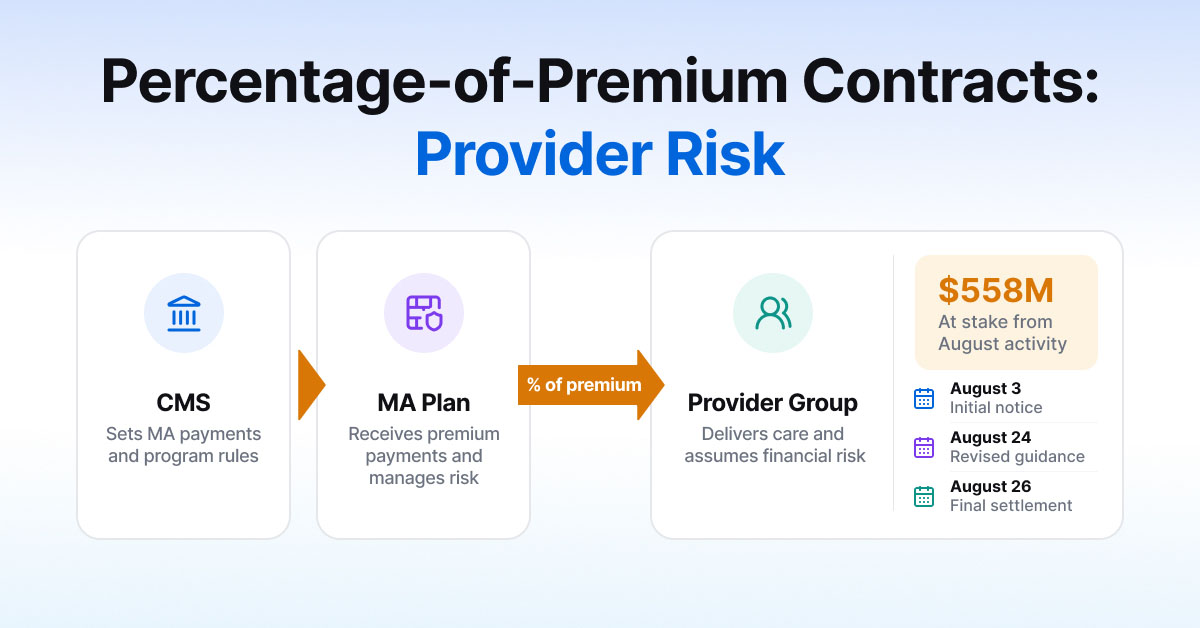
A percentage-of-premium contract pays a provider group a fixed share of what a Medicare Advantage plan receives from CMS for its members. In August 2026 the Department of Justice settled three False Claims Act cases with groups paid that way, one for $541.5 million. The theory in each: the group caused the plan to submit unsupported diagnosis codes, and the contract paid the group for it. If you hold or issue one, this is your problem too.
Three August settlements: $558 million, all provider-side
| Date | Amount | Who settled | What DOJ alleged | Contract feature named | Credit |
|---|---|---|---|---|---|
| Aug 26 | $541.5M | Provider group, 2020–2024 conduct | Codes without adequate support, or based on amendments "not initiated by the rendering provider" | Plans paid the group a set percentage of CMS revenue; three plans returned overpayments | Self-disclosed Dec 2024 under OIG's protocol; cooperation credited |
| Aug 24 | $2.4M | In-home care provider, 2021–2023 | Four HCCs coded without clinical support: protein-calorie malnutrition, substance use disorder, coagulation defects, angina | Risk-sharing: paid more when patients' risk scores rose | Cooperation credit under Justice Manual §4-4.112 |
| Aug 3 | $14.1M | MSO running practices in three states, 2020–2023 | Incorrect coding guidance for dependence and mood disorders; retrospective sweeps adding those codes | Percentage of plan payments from CMS | Whistleblower was a former associate director of risk adjustment at a plan |
The August 26 release is the largest risk-adjustment settlement on record with a physician group, and the group had already filed for bankruptcy before it was signed. The August 24 release includes a sentence every coding program should pin to the wall: a diagnosis "must have required or affected patient care, treatment, or management" at the visit. A WilmerHale summary of the three cases reads the pattern the same way: risk-sharing arrangements draw enforcement when they produce inaccurate codes, and providers that partner with plans are targets in their own right.
These followed a $556 million plan-side settlement in January, the $117.7 million add-only settlement in March covered in our piece on two-way retrospective coding, and a $56.5 million settlement in June with an in-home assessment vendor that came with a five-year Corporate Integrity Agreement. DOJ's FY2025 statistics put healthcare above $5.7 billion of a record $6.8 billion in False Claims Act recoveries, with managed care named first among the priorities. The August cases show where the next tranche comes from.
Percentage of premium: a success commission with the pen in hand
We argued in success-commission HCC coding that a vendor paid on captured RAF has every reason to overstate what the chart supports and none of the audit exposure. A provider group paid a percentage of plan premium sits in the same position with one difference: it writes the medical record. It can add a diagnosis at the visit, add one afterward through a query, or accept one from a coder who read the chart. The August releases describe all three.
The incentive, in DOJ's words. Plans "agree to pay provider groups like TVH a set percentage" of what the plan receives from CMS, so unsupported codes inflated both the plan's revenue and the group's. (August 26 release.)
I have had a version of this conversation with medical-group CFOs since the spring, and the pattern is consistent. The group inherited a coding program from a plan partner or a consultant years ago, the program was measured on RAF lift, and nobody has audited its guidance documents or its addendum practice since. The contract still pays on the plan's revenue. Nothing about that structure changed in August. What changed is that DOJ now treats the provider as a defendant, and, per the in-house versus outsourced analysis from July, the accountability gap runs straight through the contract.
Four contract terms for every capitated group
The plan's exposure runs through its providers. All three August cases involved plans returning money for codes they did not create. Contract renewals this fall are the moment to add four requirements.
Evidence on every submitted HCC. The chart sentence, the encounter, the date of service, the provider's name and credentials, and the signature. A group that cannot produce that for a sample of its own submissions cannot produce it for CMS in an audit.
Two-way review with a reported delete rate. If the group reads charts, it deletes as well as adds. An add-only program is the fact pattern in the March settlement.
Version-controlled coding guidance. Whatever the group tells coders and physicians about dependence, mood disorders, malnutrition, or any other high-weight condition should exist as a dated document the plan can read. The August 3 case turned on guidance nobody wrote down carefully.
An amendment policy. Late addenda the rendering provider did not initiate are named in the August 26 release. For any submitted diagnosis, the group should be able to show whether the supporting text was in the original note or added later, and by whom.
The vendor questions we published for compliance teams apply to a capitated group word for word.
Mock audit before renewal: the 70% benchmark
Run your own audit before someone else does. Sample your submitted HCCs the way CMS samples in RADV (the PY2024 methods are public and the RADV Hub tracks each cycle), pull the records, and validate each code against MEAT criteria with a coder who did not produce the original. Count the failures.
OIG's high-risk toolkit reports about 70% of audited high-risk codes unsupported across its plan audits, and some groups above 90%. If your rate is anywhere near that, you have a disclosure decision to make, and the August 26 release shows what cooperation credit looks like: a detailed written disclosure, prompt remediation, and cooperation through the investigation. Then fix the program so the next mock audit comes back clean.
The groups we work with run Martlet AI inside their own environment on their own charts (one value-based healthcare delivery and management company runs the full cycle this way), which means the evidence packet exists for every code before anything goes to the plan, deletes flow out with the same provenance as adds, and the coding guidance lives in a versioned configuration rather than in someone's email. The contract with the plan can keep its percentage. The codes underneath it have to hold up three years later, and now the provider is the one who answers for them. Run a mock RADV on one provider group's charts first.
FAQ
What is a percentage-of-premium contract in Medicare Advantage?
A capitation arrangement in which a plan pays a provider group a fixed percentage of the risk-adjusted revenue the plan receives from CMS for the group's attributed members. Higher risk scores raise the plan's revenue and the group's payment in the same proportion, which is why DOJ describes the arrangement as an incentive to add diagnoses.
Can a provider group be liable under the False Claims Act if the plan submitted the codes?
Yes. The statute reaches anyone who causes a false claim to be submitted. All three August 2026 settlements were with providers or MSOs whose codes flowed to CMS through a plan's submission, and the plans returned money as well.
Does self-disclosure reduce the penalty?
DOJ's Justice Manual §4-4.112 provides credit for voluntary disclosure, cooperation, and remediation. The August 26 release describes a December 2024 self-disclosure under OIG's Health Care Fraud Self-Disclosure Protocol as an important factor in resolving the matter. The credit is discretionary and depends on timeliness and completeness.
Which conditions appear most often in the 2026 provider settlements?
Substance use and alcohol dependence, major depressive and other mood disorders, protein-calorie malnutrition, coagulation defects, and angina. Each carries a meaningful HCC weight and each is easy to overstate from a problem list or a screening tool.
What should a plan add to a capitated provider contract now?
A requirement to produce page-level evidence for submitted HCCs on request, a two-way review obligation with reported delete rates, written and version-controlled coding guidance, and an amendment policy that records who added what to a note and when.
Does running mock RADV audits on provider data require sending PHI to a vendor?
Not with Martlet AI. The engine runs on-premises, in your private cloud, or air-gapped, so the group's or the plan's charts stay inside its own network and its existing security controls apply.