

What counts as defensible documentation for risk-adjustment payment in 2026 isn't what counted in 2023. The MEAT framework hasn't changed. What's tightened is the specificity required for V28 codes, and the audit cadence that will test the documentation. For Chief Compliance Officers, Chief Medical Officers, and CDI program leaders, the question this year is what tighter looks like, and what's going to survive a RADV review that's about to expand.
I've seen CDI programs that look good on paper and fail in production because they were built around the V24 documentation bar. The bar has moved. The operational redesign below is what catching up looks like.
What MEAT requires, restated for 2026
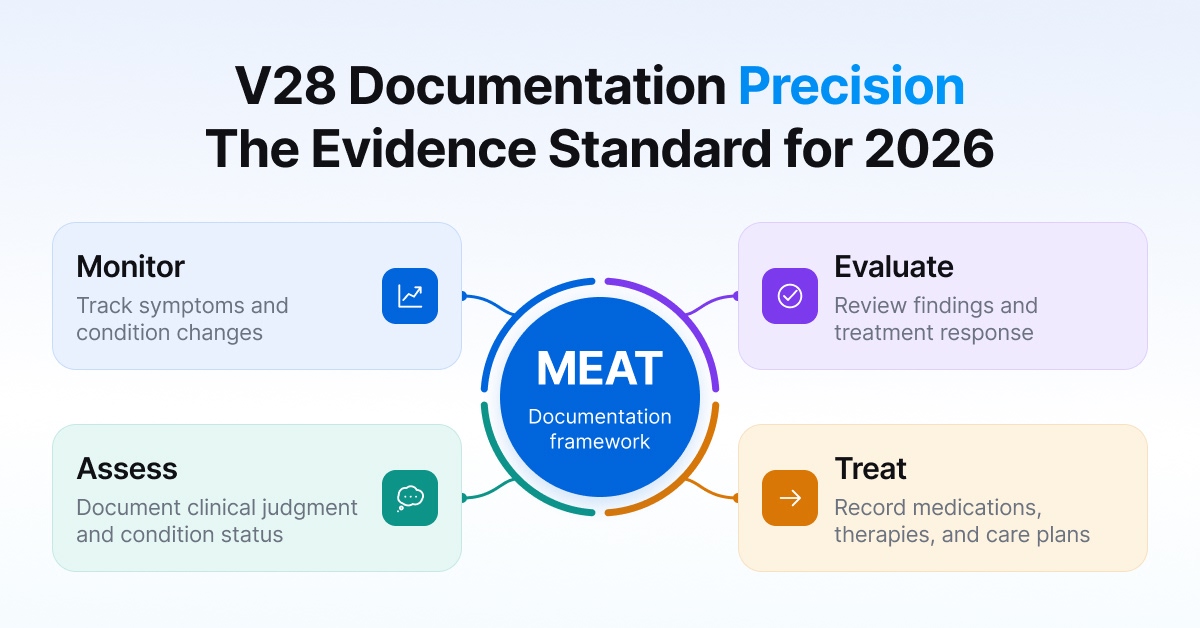
MEAT (Monitor, Evaluate, Assess, Treat) is the documentation framework for risk-adjustment diagnoses. A chronic condition submitted for risk adjustment needs documentation that the condition was, in the encounter, monitored, evaluated, assessed, or treated.
- Monitor: documented tracking (lab values, repeat measurements, symptom tracking).
- Evaluate: documented review of test results, imaging, or clinical findings related to the condition.
- Assess: documented clinical judgment about current status.
- Treat: documented active intervention (medications, procedures, therapy).
A diagnosis with one or more clearly documented MEAT components, signed by the treating provider on a current DOS, is defensible. A diagnosis with no documented MEAT support, appearing in a problem list but nowhere addressed in the encounter, is not.
The Commonwealth Fund January 2026 explainer summarizes the policy environment. The CMS Rate Announcement for 2026 describes the model framework V28 operates under.
What V28 changed about the documentation bar
V28 didn't rewrite MEAT. It changed three things about how MEAT applies in practice.
Specificity requirements tightened. Many V28 HCC categories require more specific ICD-10 documentation than the V24 equivalent. A diabetes diagnosis previously coding to a general HCC under V24 may not map to any HCC under V28 if documentation doesn't specify complications, severity, or related conditions. MEAT has to support the specific code, not just the general condition.
The 2,000 removed codes change prioritization. Conditions whose codes were removed in V28 don't need MEAT-tight documentation for risk-adjustment purposes anymore (though they may still matter clinically). Reverse: conditions newly mapped under V28 need MEAT documentation as of the first DOS in 2025 to count for the 2026 payment year.
Reweighting redistributes audit attention. Conditions whose weights increased under V28 are likely to draw more audit attention because dollar impact of a clawback is larger. Documentation for these conditions needs to be tightest.
The DOJ framework reinforces the bar
The March 2026 False Claims Act settlement reinforced a structural finding: a Medicare Advantage organization with evidence a diagnosis is unsupported, that continues to claim payment for it, is exposed to False Claims Act liability. For CDI programs, this changes operational scope. Traditional CDI focuses on improving documentation for new diagnoses identified through provider education and prospective workflows. The 2026 environment also requires identifying documentation that previously supported submitted diagnoses but no longer does, because original documentation was weak, the condition resolved without being deleted, or V28's specificity changes raised the bar.
What the operational redesign looks like
A V28-current, audit-defensible CDI program runs four loops.
The prospective documentation loop. At the point of care, providers receive specialty- and visit-scoped suggestions for HCC opportunities, each with the supporting evidence and the documentation language that would meet MEAT for the specific V28 code. Documentation flows into the encounter note as primary record.
The retrospective verification loop. After the encounter, a retrospective sweep verifies that diagnoses documented in the note carry MEAT-compliant supporting language for the specific V28 code submitted. Discrepancies (diagnoses without MEAT support, or with wrong specificity for V28) surface to coder review, not as additional queries to the physician.
The two-way audit loop. Quarterly or on rolling cadence, the program identifies previously submitted diagnoses whose ongoing MEAT support has lapsed. These get the delete or modify treatment.
The provider education loop. Patterns emerging from the three loops above feed back to provider education. Specialties with high MEAT-failure rates on specific V28 codes get targeted intervention.
The four loops, together, are the difference between a CDI program that survives an aggressive RADV cycle and one that doesn't.
What documentation actually has to look like
For type 2 diabetes with hyperglycemia (ICD-10 E11.65, an HCC under V28), MEAT-compliant documentation in an encounter note might read:
"Type 2 diabetes with hyperglycemia. A1c today 8.4, up from 7.9 in November. Continue metformin 1000mg BID, increase glipizide to 10mg daily. Recheck A1c in 8 weeks. Patient counseled on dietary management."
One paragraph, all four MEAT components: monitoring (A1c trend), evaluation (A1c result), assessment (clinical decision implicit), treatment (medication change). A diagnosis with documentation this complete survives any reasonable audit.
A problem-list entry of "Type 2 diabetes" with no narrative addressing the condition does not. A retrospective sweep that surfaces the diagnosis from the problem list with no encounter-level MEAT support is exactly the kind of capture the DOJ framework now treats as exposure.
What to tell your medical director
For a CMO or CMIO who'll be asked to socialize the new documentation bar across the physician organization, the case is three points.
The MEAT framework hasn't changed. What providers were taught about MEAT in 2023 is still correct. What's changed is the audit cadence and the specificity required for V28 codes.
The provider's documentation is the primary record. Whether the program runs prospective alerts or retrospective sweeps, the audit-defensible evidence is in the encounter note. Provider documentation effort isn't optional for audit posture; it's the foundation.
V28 reweighting redistributes the priority order. Conditions in the diabetes, depression, and vascular disease families need particular attention because the V28 changes concentrate there. A two-page provider summary listing the top 20 condition families with V28 documentation patterns is a useful artifact for physician onboarding.
The Martlet AI platform is MEAT-aware end-to-end. Every HCC surfaced (in prospective alerts, retrospective sweeps, or RADV packet assembly) carries explicit MEAT validation against the specific V28 code. The evidence packet shows which sentence supports each MEAT component. Diagnoses without complete MEAT support surface separately so the program can address the documentation gap rather than submit and hope. For CDI program leaders building the four-loop redesign, the solution pages cover the engine's MEAT validation specifics; the related RADV piece covers the adjacent compliance scope.
FAQ
Does V28 require new MEAT documentation patterns, or tighter use of existing ones?
Tighter use of existing patterns. MEAT is unchanged. What changed is the specificity of codes that count under V28 and the corresponding need for documentation supporting the specific code.
Most common documentation failure pattern under V28?
Problem-list-only diagnoses without encounter-level MEAT support. Vulnerable under V24 too; under V28 with heightened enforcement, untenable.
How quickly should a CDI program rebuild around the four loops?
Prospective and retrospective verification loops in place before the next risk-adjustment data submission deadline. Two-way audit loop and provider education loop can phase in over 6 to 12 months.
Does the documentation bar differ by specialty?
MEAT applies the same way across specialties. Specialists' documentation is usually more clinically detailed, which more naturally supports MEAT. Primary care under time pressure is where the documentation gap is widest.
MEAT and V28 specificity: relationship?
MEAT is whether the condition was addressed in the encounter. V28 specificity is whether the code is detailed enough to map to the right HCC. Both have to be satisfied for a defensible diagnosis.